DSC

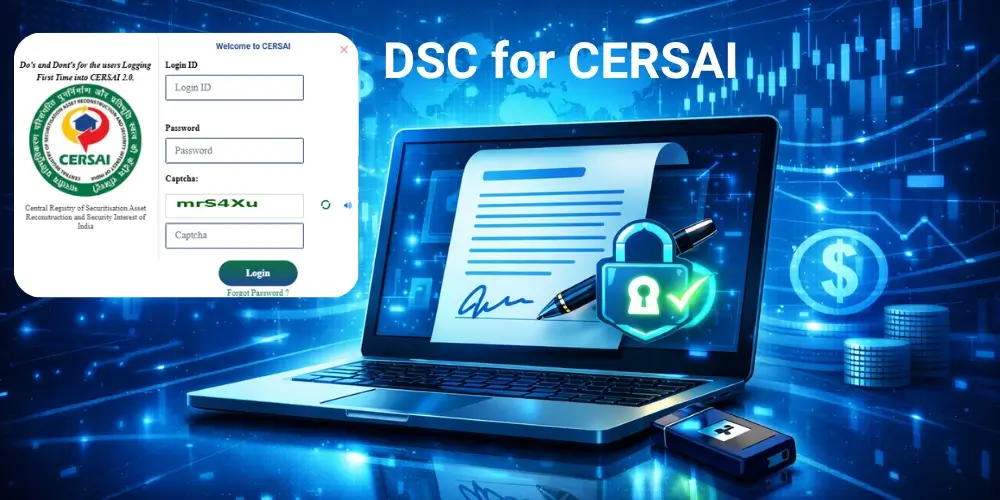
DSC for CERSAI

How to Get DSC for CERSAI Registration

In India’s financial and banking ecosystem, secure digital authentication is essential for regulatory compliance and online filings. One of the key requirements for institutions registering on the CERSAI portal is a Digital Signature Certificate. DSC for CERSAI (The Central Registry of Securitisation Asset Reconstruction and Security Interest of India) to guarantee the authenticity, legal validity, and integrity of any document(s) submitted through the portal. To provide security for accessing and submitting documents, all financial institutions, including banks, NBFC’s, and other authorised bodies, will be required to use an electronically stored Digital Signature Certificate (DSC) using a USB Token. What is DSC for CERSAI? A DSC for CERSAI is a Class 3 Digital Signature Certificate used by authorised officials of financial institutions to digitally sign documents submitted to the CERSAI portal. The Digital Signature in CERSAI acts like an electronic signature and ensures: Authentication of the authorised user Integrity of submitted documents Non-repudiation of digital filings Compliance with the IT Act, 2000 CERSAI requires a Class 3 DSC with signing capability stored in a secure USB Token for registration and transaction approvals. Why is DSC Required on CERSAI? The Digital Signature for CERSAI is mandatory because the platform deals with sensitive financial data related to secured loans and asset registration. Key reasons for using DSC on CERSAI Ensures secure online authentication Prevents unauthorized access Maintains data integrity Provides legal validity for digital filings Enables paperless compliance Banks, NBFCs, and financial institutions must use DSC when performing the following actions on CERSAI: Registering security interests Modifying loan records Filing satisfaction of charge Uploading documents Authorising institutional users Types of Digital Signature Certificate for CERSAI For CERSAI portal access, organisations generally require Class 3 DSC issued by a licensed Certifying Authority. Common DSC types used in CERSAI 1. Class 3 Individual DSC Used by authorized officials such as: Bank managers Compliance officers Authorized signatories 2. Class 3 Organization DSC Issued in the name of the organization and linked with the authorized person. Features include: Organisation name in certificate Higher security authentication Compliance with institutional filings Documents Required to Get DSC for CERSAI To obtain a Digital Signature Certificate for CERSAI, applicants must submit identity and verification documents. Required documents include PAN Card of the applicant Aadhaar Card or Voter ID Passport size photograph Email ID and mobile number Organization authorization letter (for organisation DSC) In addition, the applicant must complete video verification (VKYC) as required by certifying authorities. USB Token for Digital Signature in CERSAI A USB Token is a secure hardware device used to store the Digital Signature Certificate. Benefits of using a USB Token Protects the DSC from misuse Prevents unauthorized copying Enables secure login on the CERSAI portal Ensures compliance with government regulations Popular USB token brands used for DSC include: mToken ePass Token ProxKey Token Watchdata Token The token works like a digital identity key that must be connected to the computer during signing. Step-by-Step Process to Get DSC for CERSAI Obtaining a Digital Signature Certificate for CERSAI is a simple process if you follow the correct steps. Get meradsc.com Fill in your details. Upload the required documents. Complete video verification. Receive your DSC with Token. How to Register DSC on CERSAI Portal Once you receive your Digital Signature for CERSAI, you must register it on the portal. Steps to register DSC on CERSAI Visit the CERSAI official portal Log in using institutional credentials Go to User Management Select Register Digital Signature Certificate Insert the USB Token into the computer Select your DSC and confirm After registration, you can use the Digital Signature in CERSAI to sign and submit filings.

How to Get DSC for CERSAI Registration Read More »

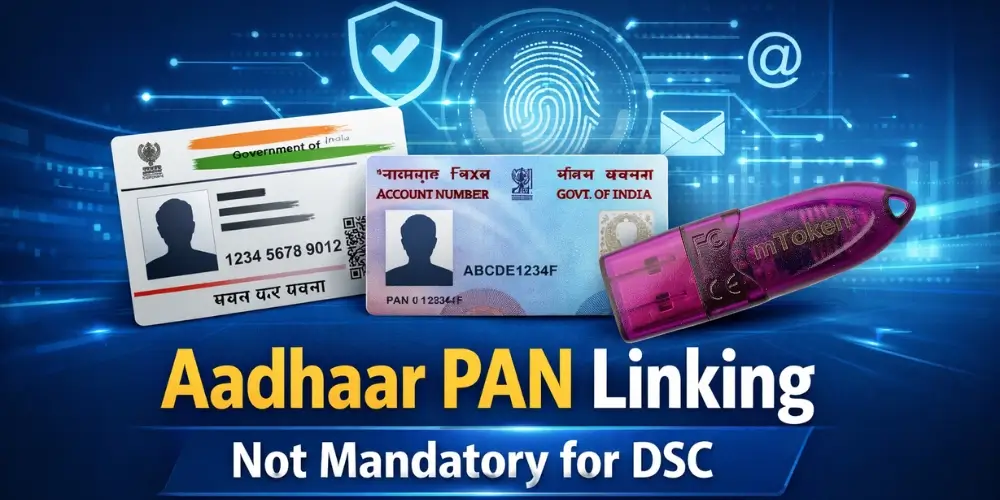
Aadhaar PAN linking is NOT mandatory for obtaining a DSC

IVG New Guideline: Is Aadhaar PAN Linking Mandatory for DSC?

A recent update of IVG (Identity Verification Guidelines) has brought a lot of changes to the applicants of the Digital Signature Certificate (DSC) in India. Among the clarifications which should be regarded as the most important is connected with such a long-debated question: Is Aadhaar PAN Linking required to issue DSC? The short answer: No, Aadhaar–PAN linking is no longer mandatory under the revised guidelines. This is significant to the people, businesses and workers, who were previously unable to obtain a DSC due to a mismatch or lack of Aadhaar and PAN. Major Update: Aadhaar PAN Linking Requirement Removed As per Section 1.9 of the revised IVG: Section 1.9 has changed to imply that Aadhaar does not need to be linked to PAN. This means: 1. Applicants can now obtain a Digital Signature Certificate even if: Aadhaar is not linked with PAN. Aadhaar is unavailable. Aadhaar details mismatch with the PAN database. 2. PAN remains a valid identity document independently. 3. Aadhaar authentication is now only one of multiple verification methods — not compulsory. Why This Change Matters Earlier, many applicants faced rejection because: Aadhaar-PAN linking was incomplete. Mobile number not linked with Aadhaar. Aadhaar demographic mismatch. NRI applicants lacked Aadhaar. The new rule removes these barriers and improves accessibility. Section 1.25 Deleted: Physical Verification Requirements Simplified Section 1.25 is completely done away with. It was employed to refer to additional procedures of physical checks. The deleted provisions included: Optional physical verification procedures. Document checks and neighbourhood enquiry. Use of specific OID verification protocols. Manual identity confirmation layers. Impact of This Deletion The removal simplifies DSC issuance significantly: Faster approval timelines. Reduced compliance complexity for Certifying Authorities. Less documentation burden on applicants. More streamlined verification processes. This is expected to accelerate the adoption of DSC across businesses and government compliance platforms. New Section 2.7: CA Assisted Enrollment Mode Introduced A new provision — Section 2.7: CA Assisted Enrollment Mode for DSC Issuance — has been introduced. This is a major addition designed to include applicants who cannot complete Aadhaar-based online verification. Who Can Use CA Assisted Enrollment Mode? The new mode applies to: Applicants without Aadhaar. Applicants are unable to complete online Aadhaar authentication. Individuals requiring physical verification-based assurance. Special category applicants. Foreign nationals and NRIs. Cases with demographic mismatches. Organisations requiring enhanced identity assurance. What is CA Assisted Enrollment Mode? CA Assisted Enrollment Mode means the Certifying Authority (CA): Performs identity verification manually or through alternative methods. Uses approved documentation and verification processes. Provides assurance equivalent to Aadhaar-based authentication. This ensures inclusivity while maintaining security standards. PAN Without Aadhaar Linking: Now Possible Apply for DSC With the revised guidelines, applicants can now obtain a Digital Signature Certificate (DSC) using PAN even if it is not linked with Aadhaar, as the mandatory Aadhaar–PAN linking requirement has been removed. Applicants can: Apply using PAN + other identity documents. Choose CA-assisted verification. Complete video verification or physical verification if required. Obtain Class 3 DSC without Aadhaar linkage. This is especially beneficial for: Senior citizens. Business owners with Aadhaar issues. Non-resident Indians. Professionals with multiple PAN records historically. Corporate directors and authorised signatories. Benefits of the New IVG Guidelines The revised rules bring several advantages: For Applicants No dependency on Aadhaar linking. Higher approval success rate. Faster enrollment. More flexible identity verification options. For Businesses and Professionals Easier onboarding for employees and directors. Simplified compliance for MCA, GST, and Income Tax filings. Reduced delays in tender participation and e-procurement. For Certifying Authorities Standardised enrollment pathways. Improved coverage for special categories. Reduced rejection cases. What Applicants Should Do Now If you were previously rejected due to Aadhaar issues, you can now: Reapply for DSC. Opt for CA Assisted Enrollment Mode. Use PAN with an alternate identity proof. Complete verification through authorised RA partners like MeraDSC.

IVG New Guideline: Is Aadhaar PAN Linking Mandatory for DSC? Read More »